
Welcome to WGS!
Women’s, Gender, and Sexuality Studies is an interdisciplinary program with contributions from faculty across campus and beyond. Our alumni are employed in social service work, health services occupations, business, law, education, and government at all levels.
Women’s, Gender, and Sexuality Studies is also an excellent second major or minor for students in a wide variety of disciplines, such as anthropology, biology, mathematics and statistics, nursing, political science, psychology, political science, sociology, English, social work, and history.
Women’s, Gender, and Sexuality Studies students gain a more complete understanding of how the social construction of gender has influenced the roles, contributions, and experiences of both women and men in many different cultures, now and in the past. Such awareness can help them better understand our contemporary world with its changing roles for all.
Women’s, Gender, and Sexuality Studies helps orient students to:
• better understand our contemporary world with its changing roles for all;
• appreciate the complexity of how gender interacts with race, social class, sexual orientation, and other forms of diversity;
• draw connections between Women’s, Gender, and Sexuality Studies and other disciplines across the university;
• appreciate how scholarship in WGS Studies informs activism and social change, historically and in the present;
• develop the critical intellectual capacity and communication skills to work with, value and improve the lives of others in whatever public or private spheres they choose.


WGS @ Work Series Come see what Women's, Gender, and Sexuality Studies Program has to offer with our "WGS @ Work Series (Click on to get more details)
Upcoming Events
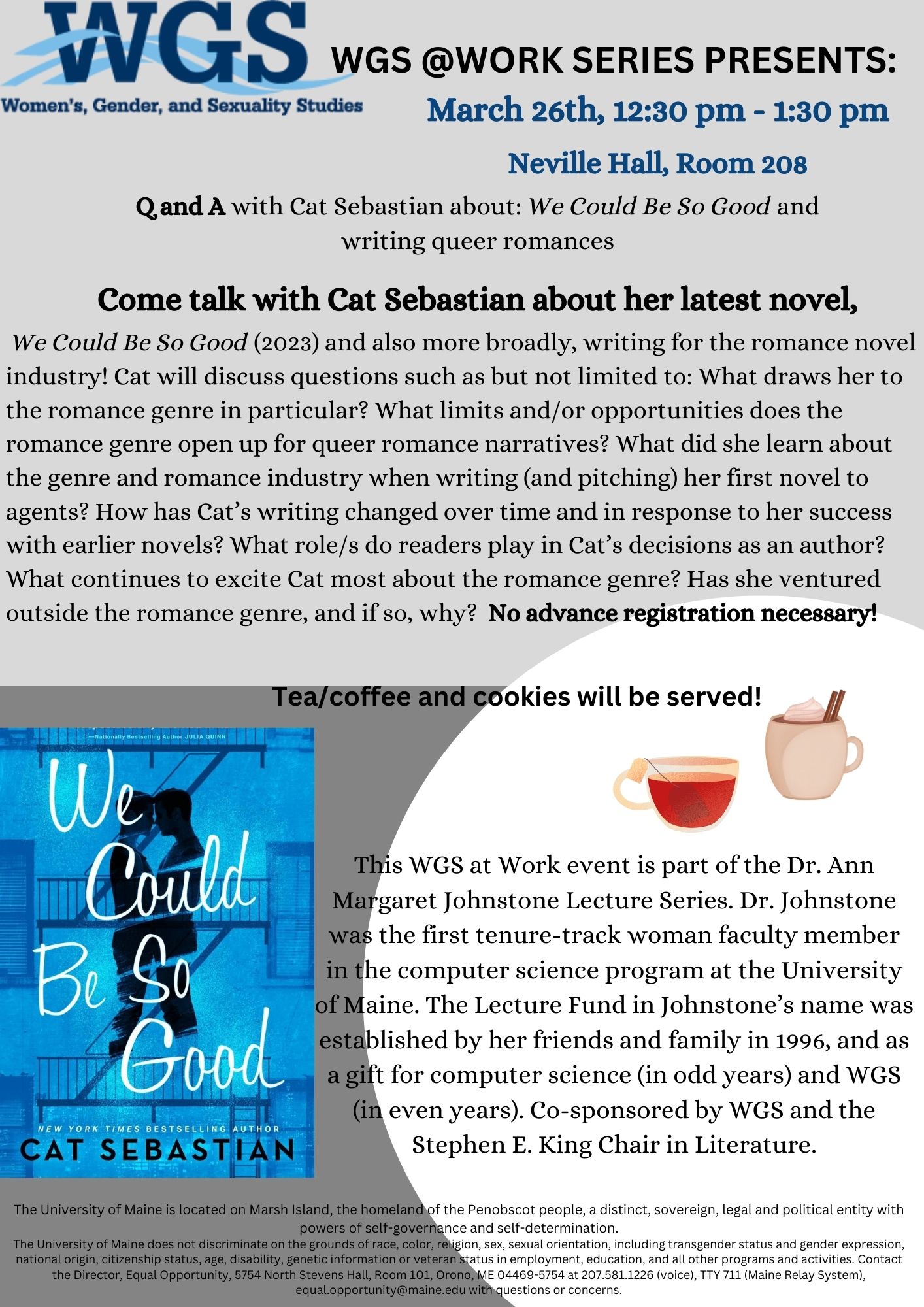
WGS @ Work Series Presents: Come Talk with Cat Sebastian about her Latest Novel.
Q and A with Cat Sebastian about We Could Be So Good and writing queer romances
12:30 to 1:30, Neville Hall, Room 208
Come talk with Cat Sebastian about her latest novel, We Could Be So Good (2023) and also more broadly, writing for the romance novel industry! Cat will discuss questions such as but not limited to: What draws her to the romance genre in particular? What limits and/or opportunities does the romance genre open up for queer romance narratives? What did she learn about the genre and romance industry when writing (and pitching) her first novel to agents? How has Cat’s writing changed over time and in response to her success with earlier novels? What role/s do readers play in Cat’s decisions as an author? What continues to excite Cat most about the romance genre? Has she ventured outside the romance genre, and if so, why? Tea/coffee and cookies will be served! No advance registration necessary!
This WGS at Work event is part of the Dr. Ann Margaret Johnstone Lecture Series. Dr. Johnstone was the first tenure-track woman faculty member in the computer science program at the University of Maine. The Lecture Fund in Johnstone’s name was established by her friends and family in 1996, and as a gift for computer science (in odd years) and WGS (in even years). Johnstone was a poet and writer who had a love for Women’s Studies (as it was then called), and the lecture fund is intended to support women’s efforts across all disciplines in creative expression.
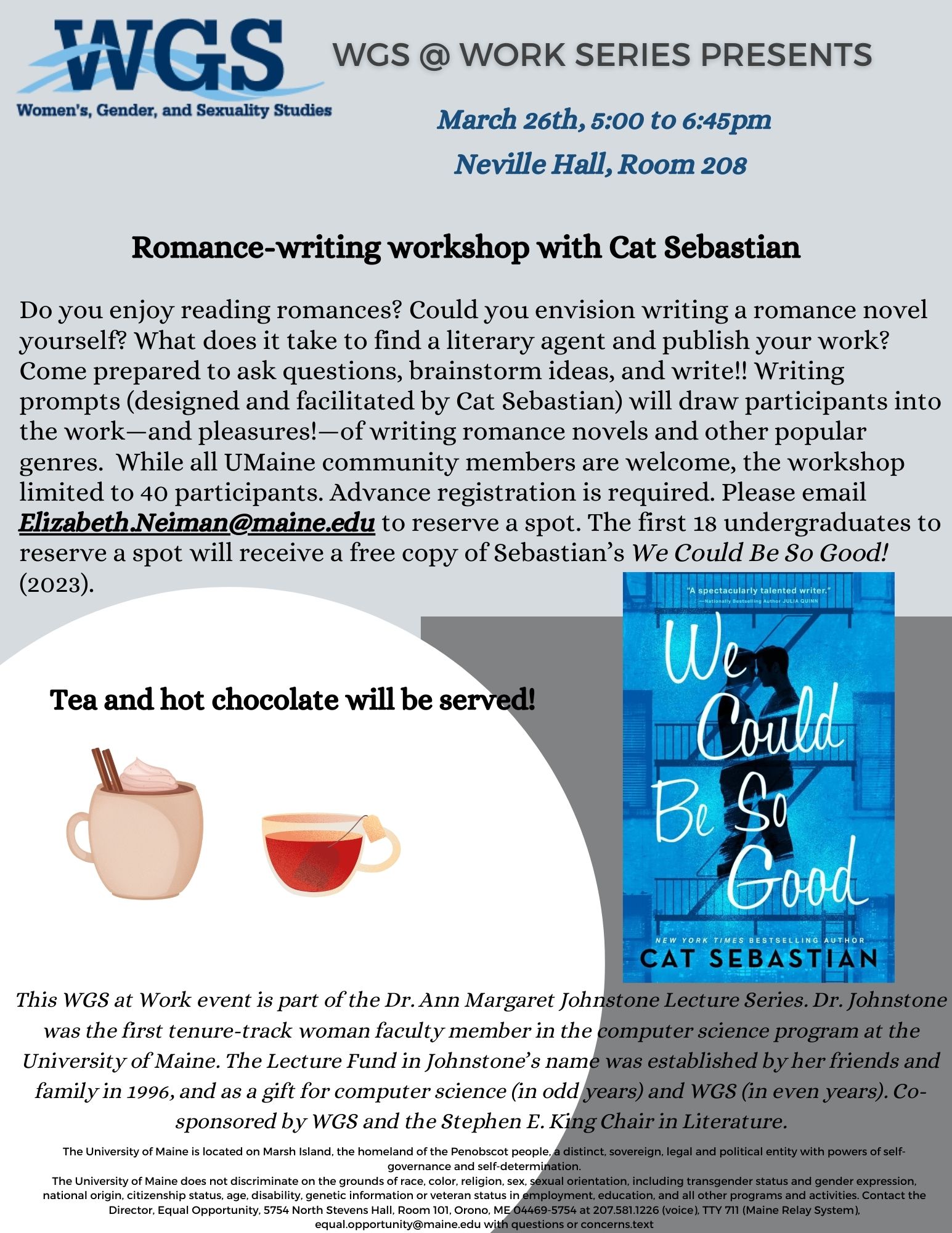
WGS @ Work Series Presents:
Q and A with Cat Sebastian followed by romance-writing workshop
March 26th, 5:00 to 6:45, Neville Hall, Room 208
Do you enjoy reading romances? Could you envision writing a romance novel yourself? What does it take to find a literary agent and publish your work? Come prepared to ask questions, brainstorm ideas, and write!! Writing prompts (designed and facilitated by Cat Sebastian) will draw participants into the work—and pleasures!—of writing romance novels and other popular genres. Tea and hot chocolate will be served! While all UMaine community members are welcome, the workshop limited to 40 participants. Advance registration is required. Please email Elizabeth.Neiman@maine.edu to reserve a spot. The first 18 undergraduates to reserve a spot will receive a free copy of Sebastian’s We Could Be So Good! (2023).
This event is sponsored by the Dr. Ann Margaret Johnstone Lecture Series, the WGS program and the Stephen E. King Chair in Literature. Dr. Ann Margaret Johnstone was the first tenure-track woman faculty member in the computer science program at the University of Maine. The Lecture Fund in Johnstone’s name was established by her friends and family in 1996, and as a gift for computer science (in odd years) and WGS (in even years). Johnstone was a poet and writer who had a love for Women’s Studies (as it was then called), and the lecture fund is intended to support women’s efforts across all disciplines in creative expression.
WGS @ Work Series Past Events/Discussions
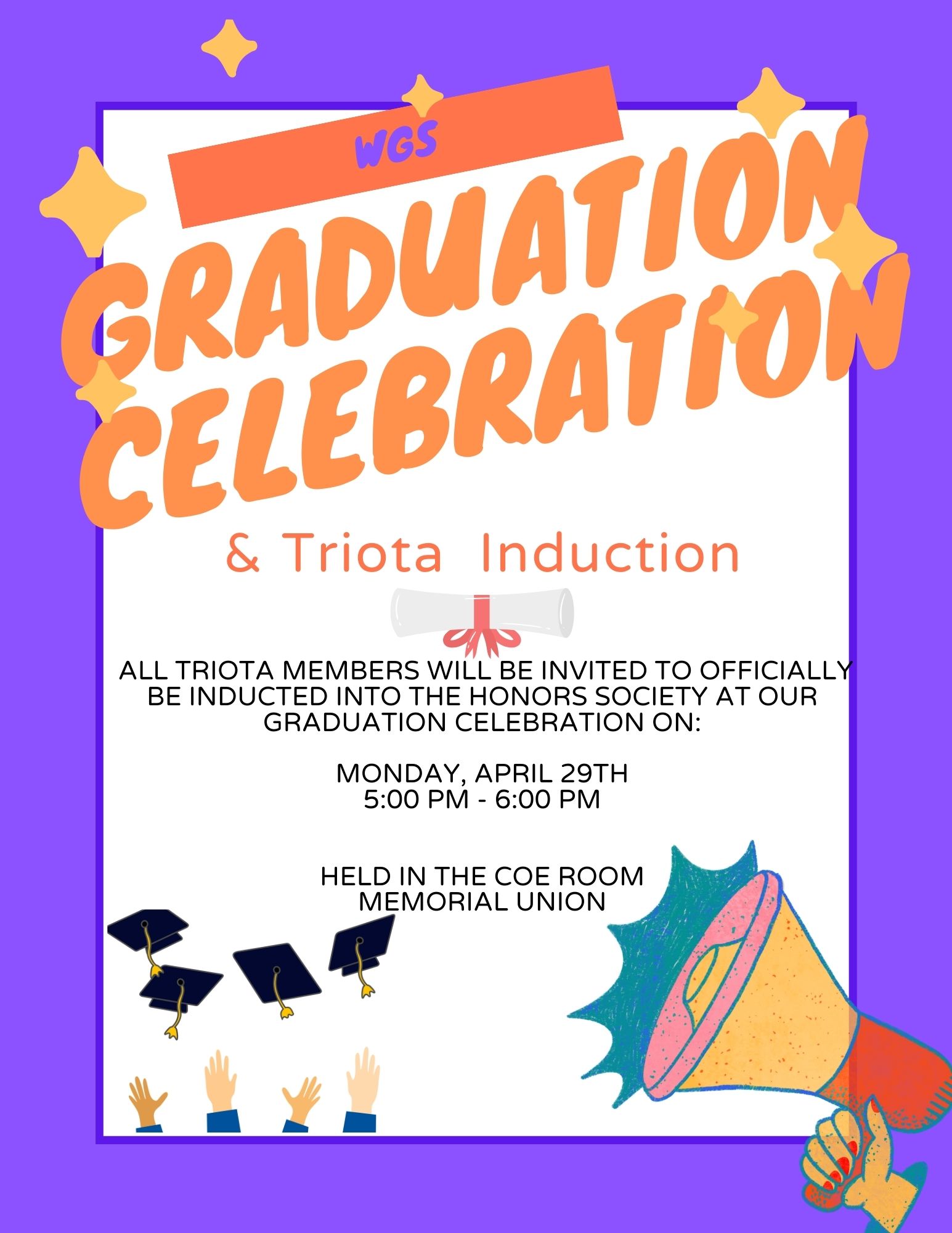
WGS 2024 GRADUATION CELEBRATION
UPCOMING NON WGS WORK SERIES EVENTS/DISCUSSIONS
“Feminism is for everybody.”
–bell hooks